
Written by: Shape Finance
PARTNER CONTENT — This article was produced in partnership with Resistant AI, a LendTech Summit partner.
As lenders push for faster decisions, the documents underpinning those decisions are becoming easier to fake and harder to check by eye. That raises a practical question about where verification should sit in an automated underwriting process.
Much of the conversation around lending automation focuses on speed: fewer manual touches, quicker decisions and more applications approved without referral. Less attention goes to the inputs those decisions rely on. For a large share of consumer and business lending, those inputs are still documents: bank statements, payslips, accounts, invoices, business licences, incorporation documents, valuation reports, and more.
The latest industry data suggests that this is becoming a point of exposure. Cifas recorded more than 444,000 cases on the National Fraud Database in 2025, the highest annual total on record. Its first-half 2026 update found that while false application filings fell overall, those for loans rose 33%, driven by personal and company unsecured loans, “particularly where altered or false documents were supplied”. Cifas linked this to the increasing sophistication of supporting documents, facilitated by AI.
Cifas itself notes that rising case numbers partly reflect better reporting. Even so, documents remain a persistent route for attempted fraud in lending.
Why documents have become a weak point
Document checks in underwriting have traditionally relied on a reviewer looking at a file and judging whether it seems right. That approach becomes a bottleneck when application volumes climb into the thousands and also works off one false assumption: fakes contain visible errors (mismatched fonts, misaligned figures or totals that don’t add up).
Generative tools can now produce any document convincingly, and template sites sell editable versions of real institutions’ documents. Cifas has pointed to “AI-enabled document forgery”, “realistic fake document websites” and fake documents “reused repeatedly across multiple applications”.
Resistant AI saw detections of AI fake grow by 90x in just under a year, a total that’s only expected to continue growing into 2027 and beyond.
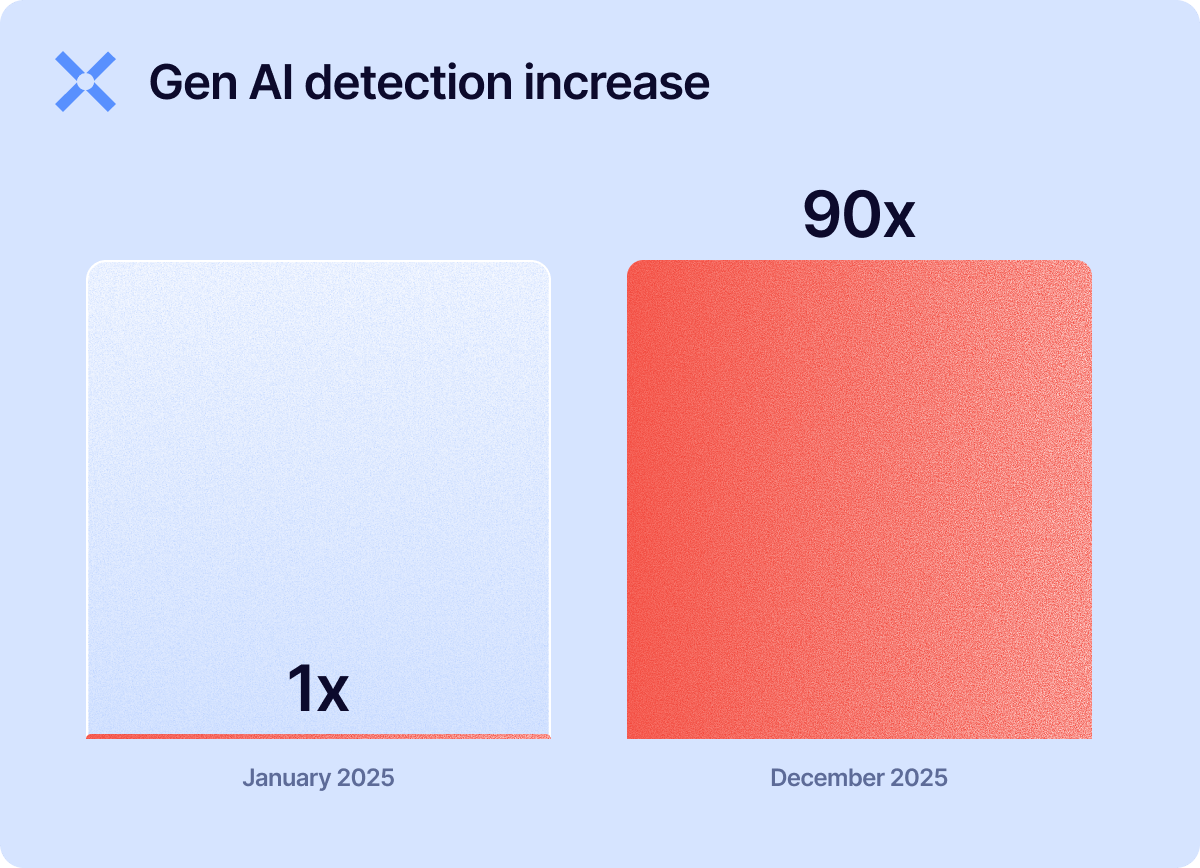
Source: Resistant AI. Detections of AI-generated documents, indexed to January 2025 = 1x. Resistant AI’s video on how AI-generated documents have improved over time
The concern is not limited to the UK. Experian’s head of fraud and identity for Australia and New Zealand recently said that detecting AI-generated income documents manually was “nearing on impossible”, naming mortgages and vehicle finance as the areas of greatest exposure.
The threat is also broader than organised crime. Some of the hardest cases are first-party: genuine applicants inflating income or editing a statement to secure a better rate or a larger loan. These applications come from real people with real credit histories, so identity and bureau checks may not flag them.
One risk and analytics leader at a UK SME lender told us that fraud “doesn’t get talked about enough”, and that AI is making it easier to obtain a loan with a dishonest application, particularly as lenders lower barriers to promote lending.
The cost rarely stays with one loan
A fraudulent application that gets through is not always a contained loss. It can surface later as an early payment default, and by then the loan is on the book.
For lenders that fund through forward flow agreements, securitisation or loan sales, the consequences extend further. Higher early defaults affect portfolio performance, can trigger repurchase obligations depending on the funding agreement, and may weaken the terms of future funding. A small number of bad files can shape how investors view the quality of the whole book.
The obvious response is to tighten controls: more manual review, stricter policy and higher provisions. But this creates its own costs. Honest applicants wait longer, conversion can fall and operations teams absorb the extra workload. Meanwhile, the most convincing fakes may still pass a visual check.
The cost can go beyond delay. A credit decisioning leader at a European digital consumer lender told us that where a lender relies on manual checks, some customer segments stop being profitable to serve at all, and lenders may choose not to serve them.
This is the trade-off at the centre of the issue. Lenders want automation to move faster, yet the more decisions are automated, the fewer documents a person reviews. Resistant AI frames it as a false choice between growing fast and letting fraud through, or playing safe and stalling. That framing is commercial, but the tension it describes is real for any lender pursuing straight-through processing.
Checking how a document was made, not what it says
Resistant AI, whose UK customers include Close Brothers Motor Finance, is one of several vendors taking a forensic approach to this problem. Its loan underwriting product does not try to verify whether a stated salary or balance is true. Instead, it examines how the file was constructed: its structure, layout and metadata.
The logic is that editing a PDF or generating one with AI can leave technical traces that a person cannot see. The company says it checks for more than 500 such indicators and returns a result in under 20 seconds per document.
Three features of this approach are relevant for lenders:
- Coverage across document types. Because the analysis focuses on construction rather than content, the same checks can apply to bank statements, payslips, balance sheets, certificates of incorporation, valuation reports, vehicle registration documents and trade finance paperwork, in any language.
- An explanation, not just a score. The output is a verdict with the evidence behind it. This matters for reviewers deciding whether to decline, and for lenders who need to justify decisions to customers, auditors or regulators.
- Data handling. Resistant AI says it does not read or extract the personal data in a document, which it argues makes the service GDPR compliant by design. As with any vendor, lenders would assess data handling, retention and security through their own due diligence.
The product is delivered through an API and is increasingly embedded in other platforms. In the US, document processing firm Ocrolus has added Resistant AI’s forensics to its own fraud detection product. This reflects a wider pattern: specialist checks plugged into existing workflows rather than standalone systems, echoing the integrated versus modular debate in lending technology.
What the evidence shows, and what it doesn’t
One published example is Close Brothers Motor Finance. According to Resistant AI’s case study, the lender began using the product in August 2024 after a single fraudulent application: an £86,000 finance agreement on a £135,000 car, on which payments stopped after four months.
The case study reports that the trial immediately surfaced 18 further fraud cases. It also says the fraud assessment step, previously around 15 minutes of a 30 to 35-minute manual review, now takes about 12 seconds. Headline results are given as £800,000 saved in eight months and a 22x return on investment.
Kit Loughlin, Senior Fraud Control Manager at Close Brothers, is quoted noting a second-order effect: the tool has “got people finding ways to put better controls in place”. This may be the more durable benefit. Clear evidence on why a document was flagged can improve a fraud team’s understanding of the threats it faces, not just its throughput.
These figures need context. They are published by the vendor, with no stated methodology for the savings or ROI calculations. Resistant AI’s wider claims of 3x more fraud detected, 5x faster underwriting and a 92% average reduction in manual reviews are similarly self-reported.
One of its own figures is perhaps the most useful for lenders: an average out-of-the-box detection rate of 86% before training on a client’s data. Lenders will want to see how that compares with their current checks, which is where a pilot on their own data helps. It also confirms that forensic analysis is one layer of defence rather than a complete answer.
There are also structural limits. A document can be technically untouched and still misleading, such as a genuine statement from an account used only to show temporary funds. Forensic checks examine how a document was made, not whether the underlying financial picture is accurate. Fraudsters also adapt, which means any detection model is only as good as its most recent update.
Some lenders test the financial picture in other ways. One consumer lender told us it asks applicants to state their expenses, then checks them against open banking data and goes back to the customer where the two differ. Applications are referred to an underwriter for three broad reasons: fraud concerns, mismatches between declared and observed data, and borderline credit decisions.
Where document verification fits
For lenders, the question is less whether document fraud is growing and more where verification should sit as decisions become faster and more automated.
Document forensics is one option. Open banking income verification and payroll data can reduce reliance on documents altogether, although coverage remains incomplete. In practice, many lenders are likely to need both.
For organisations reviewing their approach, several questions are worth examining:
- Where do documents still drive decisions? Which products and segments rely on uploaded documents, and how are those documents checked today?
- What happens when a document is flagged? A detection tool only adds value if there is a clear policy for what follows: automatic decline, referral or a request for further evidence.
- Can the decision be explained? In consumer lending, Consumer Duty means lenders need to treat honest customers fairly as well as stop fraud. Evidence-based flags are easier to defend than unexplained scores.
- How will performance be measured? Vendor benchmarks are a starting point. A pilot on a lender’s own historical applications, including known fraud cases, gives a more reliable picture of detection and false positive rates.
The broader lesson is that faster underwriting depends on trusted inputs. As generating a convincing document becomes cheaper, checking documents can no longer depend on a reviewer’s eye alone.
The lenders best placed to grow safely are likely to be those that treat document verification as part of their underwriting infrastructure rather than a manual step at the end.
Continue the conversation.
LendTech Summit London takes place on 17 November 2026, bringing senior UK lending leaders together at Shape Finance’s invitation-only forum to explore the challenges, decisions and opportunities shaping the industry.